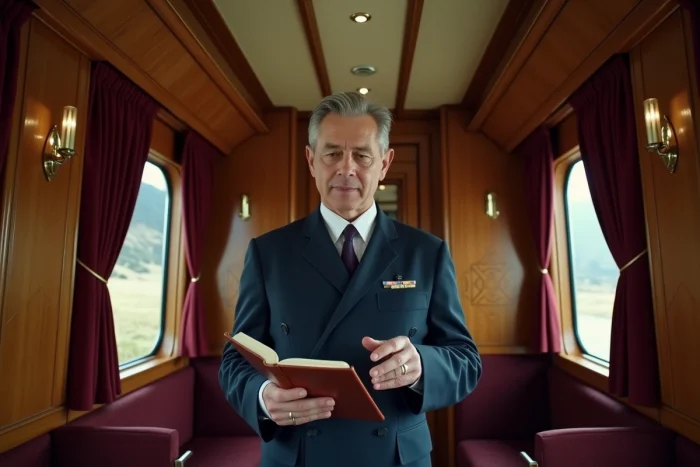
The historic Orient-Express, which connected Paris to Constantinople starting in 1883, did not transport its passengers under the same conditions as a conventional train. Its configuration of sleeping cars and dining cars significantly limited the number of available seats per train, far from the capacities of an ordinary express train of the same era.
Composition of cars and actual capacity per train
The question of how many passengers traveled on the Orient-Express simultaneously primarily depends on the composition of the train. The International Sleeping Car Company (CIWL), founded by Georges Nagelmackers, operated cars designed for comfort rather than maximum capacity.
Each sleeping car contained a limited number of single or double compartments. The dining cars, baggage cars, and lounge cars occupied part of the train without adding sleeping accommodations. On a route like Paris-Constantinople, the train could have between four and eight passenger cars depending on the period, with the rest dedicated to service.
The result: a train transported a few dozen passengers, not hundreds. This low density was part of the product itself. The space per traveler, cabin service, and onboard dining justified fares accessible only to a wealthy clientele.
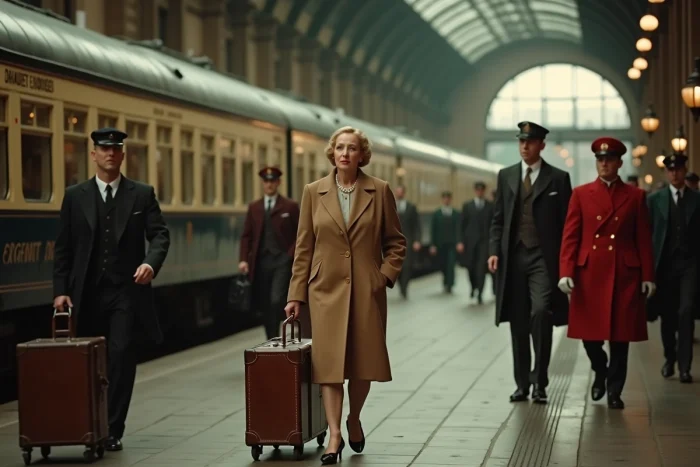
Orient-Express of the 1920s: the peak of ridership on the European network
The period between the two wars marks the peak of the Orient-Express service in Europe. The CIWL then operated several derived lines in parallel, which multiplied the total number of passengers transported under the brand.
Multiple lines, not a single train
The Simplon-Orient-Express, the Arlberg-Orient-Express, and the classic Orient-Express coexisted with distinct routes through France, Switzerland, Italy, Austria, and Hungary. Each of these services had its own composition of cars and its own frequency.
- The Simplon-Orient-Express passed through the Simplon Tunnel and served Venice, Belgrade, and then Istanbul, with sleeping cars coming from Paris and sometimes Calais
- The Arlberg-Orient-Express took a more northern route via Zurich, Innsbruck, and Budapest
- The historic Orient-Express via Strasbourg, Munich, and Vienna continued to operate, although it was competed by its own variants
By combining these services, the CIWL transported thousands of travelers per year across the entire Orient-Express network. The number per train remained modest, but the frequency of departures and the diversity of lines significantly increased the total volume.
A clientele that defined capacity
The cars of the Company were reserved for first-class passengers and sleeping cars. The trains could also include cars from state railway companies (in France, Austria, Hungary), which added lower-class seats on certain sections.
This cohabitation muddles the figures: the number of passengers on board a complete train depended on the number of CIWL cars and state cars attached that day. Capacity varied from one departure to another, with no fixed standard.
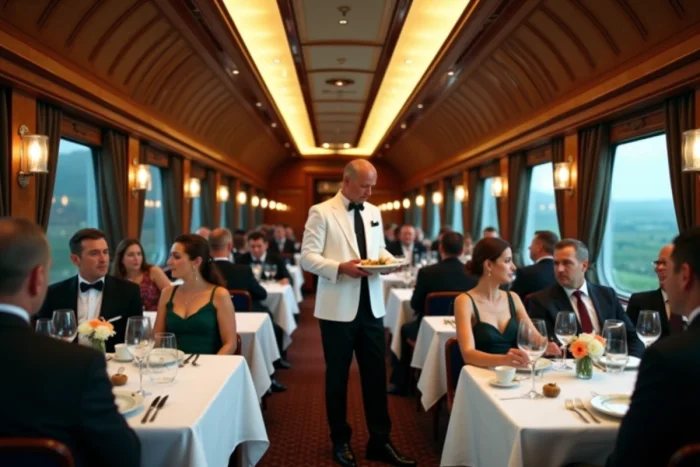
Venice Simplon-Orient-Express: the current capacity of a luxury train
The Venice Simplon-Orient-Express (VSOE), operated by Belmond, is today the most direct successor of the historic train. Its authentic cars from the 1920s and 1930s, restored with period materials, impose a very different configuration from a modern train.
The VSOE operates with sleeping cars where each cabin accommodates one or two passengers. The total number of cabins per car remains limited by the original Art Deco design. A complete train of the VSOE transports significantly fewer passengers than a TGV or an Intercity, which is an integral part of the luxury experience offered.
The dining cars of the VSOE, with their marquetry and period lighting, also take up space in the train. The ratio between service cars and sleeping cars keeps the passenger capacity at a deliberately low level.
Orient Express today: a portfolio beyond the train
The Orient Express brand no longer designates a single rail service. It now encompasses a range of distinct travel products, each with its own capacity logic.
- The La Dolce Vita Orient Express train, planned in Italy, will offer routes such as Rome-Portofino-Venice with a configuration of luxury cabins
- Hotel experiences carry the Orient Express brand in several countries
- A luxury sailing yacht, announced by Accor, extends the brand to the maritime sector
This diversification changes the way “Orient Express passengers” are counted. The number of annual travelers under this brand is no longer limited to just the occupants of a train. The commercial discourse is organized by itinerary and by the number of passengers per cabin, rather than by the overall capacity of a train.
For the future La Dolce Vita train, reservations are made by cabin with a defined number of passengers per suite type. The logic is that of floating hospitality, not mass rail transport.
The number of passengers on the Orient-Express has always been a fluctuating figure, linked to the composition of the train, the era, and the route taken. From the historic train of 1883 to current projects, the constant remains the same: a deliberately reduced capacity, conceived as a marker of luxury and not as a technical constraint.