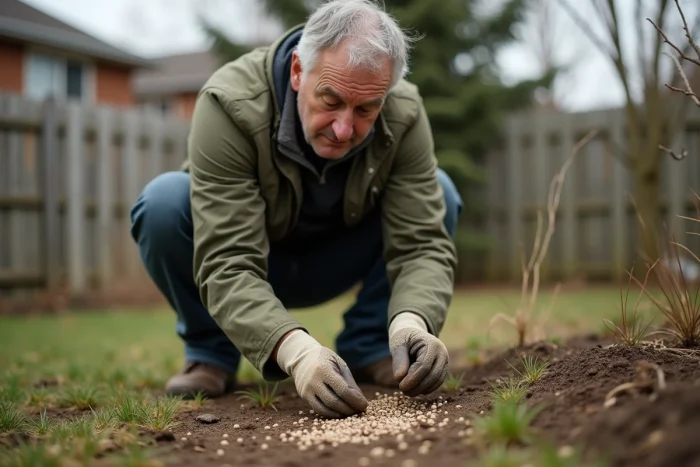
A grass seed placed on the ground without intimate contact with the soil does not germinate. The reason lies in the physiology of germination: the radicle needs stable capillary moisture and relative darkness to anchor itself. When seeds remain visible on the surface, they dry out between waterings, become targets for birds, and eventually degrade under UV rays.
Crust formation and mechanical rise of seeds after sowing
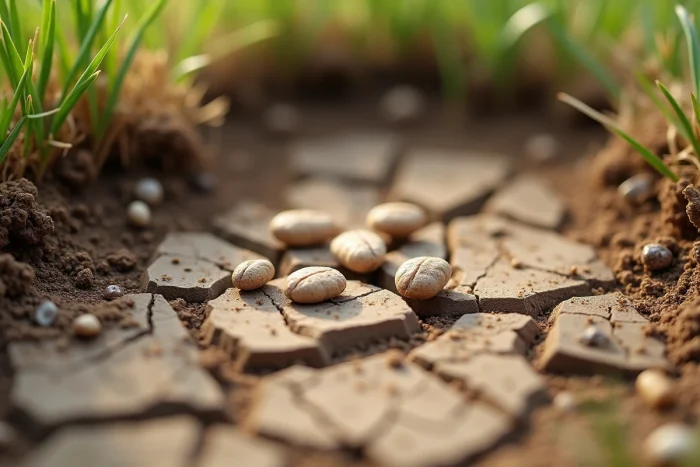
On silty and clay-silty soils, the passage of a roller that is too heavy compacts the surface layer to the point of forming a crust as it dries. Tests conducted by Wageningen University show that this crust, by cracking during wetting and drying cycles, mechanically pushes the seeds to the top of the soil.
We observe the same phenomenon with vibrating rollers used in urban landscaping. The technical solution is to favor a light roller or a honeycomb plate that presses the seed against the soil without creating a waterproof film. On silty soil, a simple pass with the back of a rake followed by a fine watering produces better seed-soil contact than a roller weighing several dozen kilos.
The problem of grass seeds on the surface worsens as soon as a rainstorm occurs within 48 hours of sowing. INRAE notes, in a 2023 report on climate and urban green spaces, that short and intense rains lead to concentrated runoff that uncovers the lightest seeds, especially on bare and even slightly sloped soil.
Coated seeds and fine grasses: two cases where the surface traps seeds
Coated seed mixtures (pelleted seed), common in consumer overseeding bags, pose a specific problem. According to tests by the Sports Turf Research Institute (STRI), coated seeds tend to stay more on the surface when the substrate is very fine or compact. The coating increases the diameter and apparent weight of the seed but reduces its ability to settle into the micro-crevices of the soil.
With fine grasses like perennial ryegrass or creeping fescue, the bare seed is so light that a gust of wind or a jet of water can move it. In this case, we recommend a light cross-raking at shallow depth (a few millimeters are sufficient) followed by a layer of sifted potting soil. This potting soil acts as a cover, retains moisture, and prevents the seed from migrating.
When the potting soil itself becomes the problem
A potting soil that is too coarse or too dry repels water instead of absorbing it (hydrophobic effect). The seed, placed between particles that retain nothing, remains exposed to the air. Before spreading a cover soil, it is essential to check that it moistens easily: a handful pressed in the hand should form a crumbly clump without crumbling instantly.
Soil preparation before grass sowing: the actions that change anchoring
The quality of anchoring depends on the structure of the first centimeters of soil. A soil that is too compacted at depth and powdery at the surface is the worst scenario. Here are the steps that ensure reliable seed-soil contact:
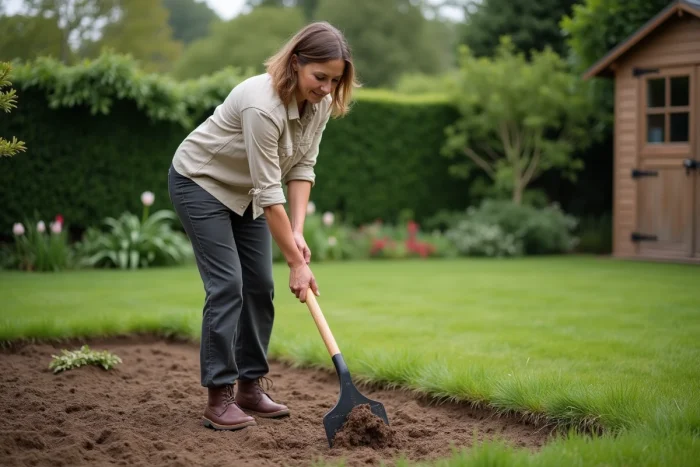
- Loosen the soil to about fifteen centimeters with a claw or a tiller at low speed, without turning the horizons, to break up clods without smoothing the surface.
- Refine the surface layer with a rake to obtain a uniform seedbed, with soil particles the size of a grain of wheat, neither finer nor coarser.
- Sow in two crossed passes (one lengthwise, one widthwise) to distribute the seeds evenly and reduce areas of density where they overlap without touching the soil.
- Lightly rake after sowing to bury the seeds under a few millimeters of soil, then roll with a light tool.
A well-prepared seedbed is better than intensive watering afterward. If the soil structure is correct, the seed naturally finds its place, and capillary water does the rest.
Watering grass sowing: frequency and intensity to avoid unearthing
The most common mistake is to water abundantly once or twice a day. A jet that is too powerful or a flow that is too strong on bare soil causes exactly the same effect as a rainstorm: runoff moves the seeds to lower areas and leaves them exposed on the surface in higher areas.
The basic rule is simple: several short and fine waterings per day rather than a single heavy pass. The goal is to keep the top few centimeters of soil constantly moist without ever creating puddles or streams of water. A misting device or a low-flow oscillating sprinkler is better than a handheld hose.
Adjusting the watering rhythm according to the weather
In overcast and cool weather, two passes per day are sufficient. In strong heat or dry wind, we move to three or four passes. The surface of the soil should never whiten between two waterings during the germination phase, which usually lasts one to three weeks depending on the species of grasses sown.
When the first shoots reach a few centimeters, watering can become less frequent but deeper, to encourage deep rooting. Water little and often at first, then a lot and rarely afterward summarizes the progression to follow.
The last point to monitor concerns the slope. On even slightly sloped terrain, surface water migrates. Placing a growth cover (non-woven type) on sloped areas limits runoff and keeps the seed pressed against the soil. This cover is removed as soon as the lawn reaches a sufficient height for the first mowing.