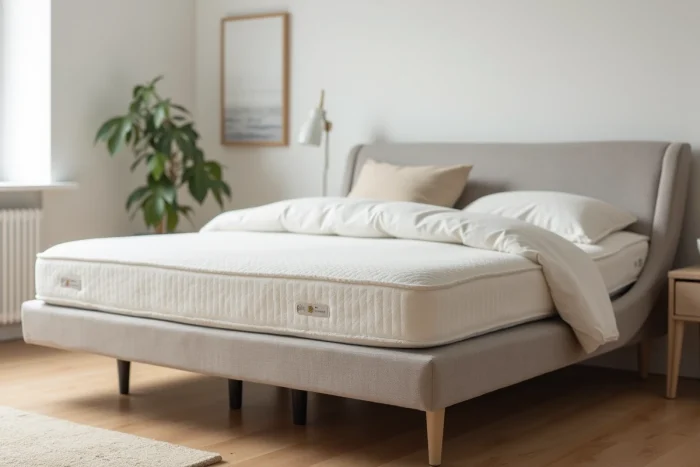
A mattress placed on an electric bed base undergoes mechanical stresses that a traditional bed does not impose: repeated flexing at the lumbar region, bending at the knees, returning to flat several times a night. The choice of filling determines the mattress’s ability to withstand these deformations without losing its support properties. Latex, due to its cellular structure, meets these constraints in a way that memory foam or pocket springs do not replicate.
Curvature radius and manufacturer warranty: the criteria that guides overlook
Several manufacturers now condition their warranty on the use of a mattress explicitly validated for an adjustable head-to-foot bed base. Nation Literie specifies in its recent guides that a non-approved mattress on an electric bed can lead to a refusal of coverage in case of premature sagging.
The technical problem is precise: each bed base imposes a minimum curvature radius and a maximum number of folds. A mattress that is too thick or too rigid strains the motor and creates break points in the filling. Latex, thanks to its natural elasticity, accommodates the bending without creating a permanent fatigue zone in the material.
A recent report on gamma mattresses on La Santé de Demain details the compatibility parameters between fillings and adjustable bed bases. Before any purchase, checking that the manufacturer explicitly mentions compatibility with relaxation beds remains the most reliable precaution.
Latex, foam, and springs on electric bed bases: comparative table
The choice between the three main types of filling is based on measurable technical criteria. Here is a summary of the behaviors observed on a slatted adjustable bed base.
| Criterion | Natural latex | Memory foam | Pocket springs |
|---|---|---|---|
| Flexibility on adjustable bed base | Very good (soft cellular structure) | Average (increased rigidity at low temperatures) | Low to average (springs resist twisting) |
| Ventilation | Good (through perforations) | Limited (closed cells) | Good (air circulation between springs) |
| Durability under repeated flexing | High (constant elastic return) | Average (possible residual deformation) | Variable (mechanical wear of springs) |
| Manufacturer warranty compatibility | Generally validated | Often validated | Rarely validated for adjustable beds |
| Firmness sensation | Firm and progressive | Enveloping (soft welcome) | Dynamic (bounce effect) |
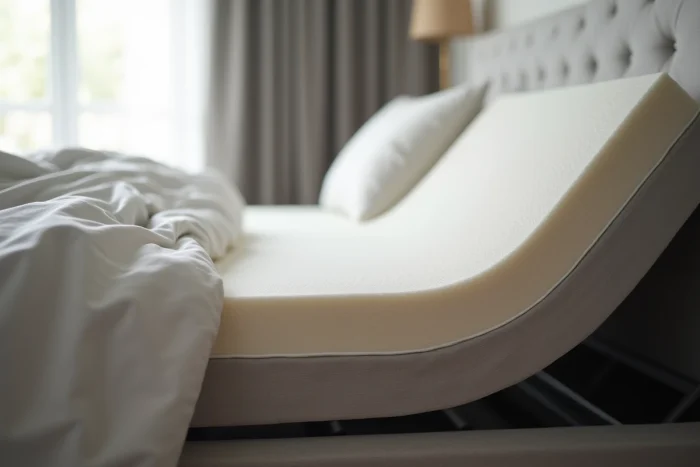
The table reveals a clear gap in flexibility and durability under repeated bending conditions. Memory foam has a flaw that is rarely mentioned: its rigidity increases when the room temperature drops, complicating the movements of the bed base in winter or in a poorly heated room.
In contrast, pocket springs maintain an advantage in ventilation comparable to that of latex. Their limitation on an electric bed lies in the mechanics: springs are not designed to be bent laterally, which accelerates their wear.
Perforations and comfort zones: what makes a latex mattress suitable for relaxation
A block of raw latex is not automatically compatible with an electric bed base. The difference lies in two manufacturing parameters.
- Transverse perforations allow the block to bend without creating a concentrated resistance point. The more numerous and regular the perforations, the more smoothly the mattress follows the joints of the bed base.
- The thickness of the block must remain contained to avoid straining the bed base motor. The ranges designed for electric beds offer blocks that are thinner than standard models, without sacrificing support density.
- The number of comfort zones (five or seven depending on the models) determines the pressure distribution on the body when the bed base is in an elevated position. Three zones are rarely sufficient for relaxation use.
Cosme Literie specifies that its natural latex mattresses for electric beds are designed with perforation and block thickness suitable to follow the joints of the bed base without excessive mechanical strain. This type of targeted design distinguishes a “compatible” mattress from one that is truly optimized for relaxation.
Natural latex or synthetic latex on electric bed
Regulations require that a mattress labeled “latex mattress” contain a block of latex with a minimum thickness of 10 cm representing at least 60% of the total height. This standard does not distinguish between natural and synthetic latex, which can be confusing.
Natural latex, derived from rubber tree sap, offers superior elasticity compared to synthetic latex (derived from petroleum). On an adjustable bed base, this difference translates concretely: the elastic return of natural latex remains stable after thousands of flexions, whereas synthetic latex gradually loses its resilience.
Conversely, synthetic latex is significantly cheaper and suitable for tight budgets. For an electric bed used daily in an elevated position (reading, respiratory issues, heavy legs), natural latex remains the most coherent choice over time.

Buying criteria for a latex mattress intended for a relaxation bed
Some checks can help avoid the most common mistakes when choosing a latex mattress for an electric bed base.
- Check for explicit mention of compatibility with adjustable head and foot bed bases in the product sheet, and not just a simple mention of “compatible with slatted bed bases.”
- Prefer a sufficiently high latex density to ensure firm support without excessive rigidity, especially if the mattress is used in a semi-sitting position.
- Ensure that the mattress comes with a warranty valid for use on an electric bed, and not just on a fixed bed base.
- Opt for a mattress with a removable and washable cover, as the elevated position exposes the mattress more to sweating at the back.
The market for relaxation bedding is evolving towards increasingly segmented offers. A latex mattress designed for a fixed bed base and a mattress designed for an electric bed do not meet the same mechanical constraints. The compatibility declared by the manufacturer remains the only reliable criterion to protect both your sleep comfort and your investment.