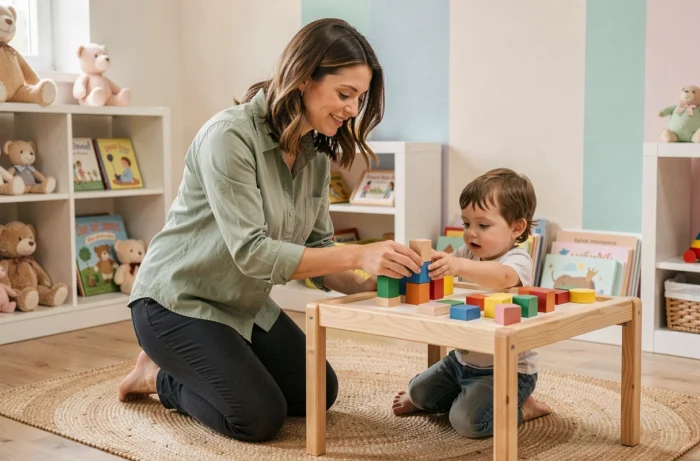
Working in early childhood after a first career in a completely different field is possible without spending three years in school. Several pathways allow access to positions with young children through short training programs, or even without a diploma for certain jobs in daycare. The framework has evolved in recent years, and the options deserve to be detailed to avoid false promises.
Working in daycare without a diploma: what the regulatory framework really allows
Daycares can now hire non-qualified staff for certain positions. This opening was designed to address the shortage of professionals in the sector. In practice, it mainly concerns the roles of support staff, who assist qualified teams with daily tasks.
Be careful not to confuse this possibility with unrestricted access to all early childhood professions. Positions such as childcare assistant or early childhood educator remain regulated and require a state diploma. Hiring without a diploma only applies to supervised roles, under the responsibility of qualified professionals.
This measure is indeed a topic of debate. Professional and union organizations contest this measure, arguing that it risks degrading the quality of care. As advised by 24 Actualités, entering without a diploma is a starting point, not a finishing line.

VAE early childhood: turning experience into a recognized diploma
Have you cared for children in your surroundings, worked in after-school activities, or served as a nanny? The validation of acquired experience (VAE) allows you to convert these activities into an official diploma, without returning to a traditional curriculum.
The VAE is based on demonstrating competencies actually exercised. The candidate prepares a file detailing their activities and then presents it to a jury. To aim for the childcare assistant diploma, for example, one must prove competencies in care and direct support for children.
A point often misunderstood: having worked in a daycare does not automatically suffice. If your role was limited to maintaining the premises, the jury will consider that care competencies were not utilized. The activities performed with children are the only ones that count for the VAE in this field.
Diplomas accessible through VAE
- The CAP AEPE (Early Childhood Educational Assistant Certificate), the reference diploma for working in daycare, in preschool, or at home. It is the most common pathway for retraining.
- The DEAP (State Diploma of Childcare Assistant), which opens up more specialized care roles with infants and young children.
- The DEEJE (State Diploma of Early Childhood Educator), accessible through VAE but significantly more demanding in terms of proof of educational and pedagogical competencies.
The VAE requires preparation time, often several months, but it avoids the need for lengthy training while leading to a diploma identical to that obtained through the traditional route.
Positions and first experiences to test the profession before diving in
Before committing to a complete retraining, it is wise to check that daily life with young children meets your expectations. Several avenues allow for this situational testing without heavy commitment.
Childcare at home, through matchmaking platforms or specialized agencies, provides a first concrete approach. This type of position does not require a specific diploma and allows one to confront the reality of the job: patience, vigilance, managing children’s rhythms.
Positions in after-school activities are a common springboard into early childhood. They allow for the acquisition of experience that can later be valued in a VAE process or during recruitment in a daycare.
Transferable skills from other sectors
Why do some profiles from commerce, hospitality, or the medico-social sector succeed particularly well in their retraining towards early childhood? Because they bring directly useful skills.
- Stress management and dealing with the unexpected, developed in service jobs, directly translate into the collective care of children.
- Active listening and non-verbal communication, acquired in care or support roles, are at the heart of working with children who have not yet verbalized.
- Logistical organization (meals, hygiene, schedules) familiar to professionals in catering or home assistance corresponds to daily tasks in daycare.
CAP AEPE in short training: the middle path for a quick retraining
The title of this article speaks of working without returning to studies. The CAP AEPE deserves to be mentioned, however, because it does not resemble a traditional school path. Several organizations offer the CAP AEPE remotely, compatible with a salaried job.
Preparation generally lasts between six months and a year depending on the chosen pace. Courses are accessible online, and practical internships in childcare facilities complement the training. For an adult in retraining, this formula avoids leaving their job overnight.
Funding often comes through the CPF (personal training account) or through a professional transition project funded by Transitions Pro. These programs cover all or part of the educational costs and, in some cases, maintain remuneration during training.
The CAP AEPE remains the most versatile diploma in the sector. It allows one to work in collective daycare, micro-daycare, preschool as an ATSEM (after passing an exam), or even at home as a licensed nanny. It is the only diploma that opens so many doors with less than a year of training.
Retraining towards early childhood without long studies is based on a simple principle: start with hands-on experience, then validate. Whether through a position without a diploma in daycare, an experience in childcare, or a VAE built on real competencies, each path is progressive. The sector is hiring, but it also expects professionals to commit to skill development. It’s better to know this from the start.