The companionship in the vegetable garden is based on a simple principle: certain plants, grown side by side, interact through their roots, their exudates, or their aerial structure. For cucumber (Cucumis sativus), these interactions are particularly important because the plant is sensitive to water stress, foliage pests, and fungal diseases. Choosing the right neighbors in the row affects the microclimate, pest pressure, and soil structure around the plant.
Functional biodiversity and cucumber: why a single companion plant is not enough
Lists of “good neighbors” circulate widely, but they often give the impression that simply planting basil next to a cucumber will solve all problems. The Royal Horticultural Society, through Guy Barter, reminds us that companionship works when it is part of a set of practices that favor soil and biodiversity, not as an isolated solution.
In practical terms, a single dill plant planted between two rows of cucumbers will have only a marginal effect. The same dill plant, surrounded by nasturtiums and dwarf clover in a mulched and living soil, participates in an ecosystem that attracts hoverflies, ladybugs, and pollinators. It is the combination that produces a result, not the unique duo.
To properly understand the association of cucumber in the vegetable garden, one must think in terms of plant layers and complementary functions rather than fixed recipes.
Cucumber companion plants: those that provide measurable benefits
Not all associations are equal. Some affect soil structure, others regulate pests or influence the microclimate. Here are the most relevant ones, classified by type of benefit.
- Peas and beans: these legumes fix atmospheric nitrogen in the soil through their root nodules. The cucumber, which is nutrient-hungry during the fruiting phase, directly benefits from this input. Planting peas upstream of the cucumber row also provides a slight windbreak for young plants.
- Radishes and carrots: their fine and taproot structure loosens the soil without competing with the cucumber’s shallow root system. The radish, with its short cycle, frees up space before the cucumber spreads.
- Lettuce and spinach: their low foliage covers the soil and limits evaporation, helping to maintain consistent moisture at the base of the cucumbers. This function of living mulch reduces the need for watering.
- Sunflower or corn: their upright growth provides a natural support and creates partial shade during the hottest hours. When summer temperatures rise, this slight shading protects the cucumber foliage from wilting.
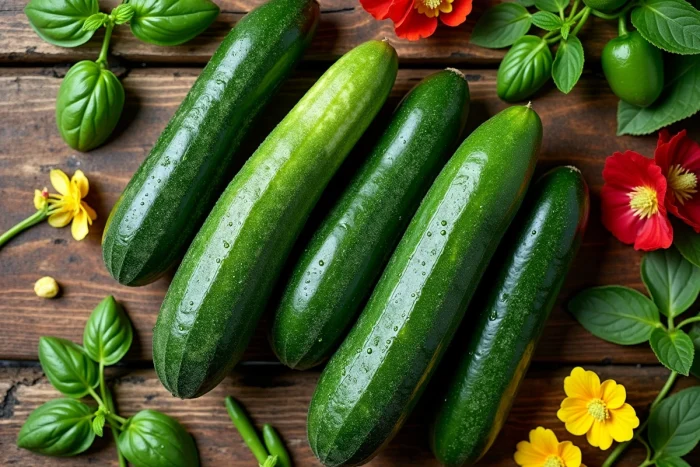
Dill and basil near cucumber: an effect that depends on management
Dill and basil are listed in most guides as “ideal companions” for cucumber. The reality is more nuanced. Their main interest lies in attracting pollinators and predatory helpers (hoverflies, parasitic wasps). But this effect depends on the flowering stage and planting density.
A dill plant that bolts too quickly loses much of its attractiveness to beneficial insects. Dill should be sown staggered, every three weeks, to maintain continuous flowering throughout the cucumber season. A single sowing in spring will provide a utility window of only a few weeks.
For basil, direct proximity to cucumber can create competition for water in light soil. It is better to place it at the edge of the bed rather than between the plants, especially in sandy soil.
Neighbors to avoid near cucumbers in the vegetable garden
Some plants pose real cohabitation problems. Confusing them with mere “bad associations” would be reductive: the mechanisms at play are concrete.
Potatoes and cucumbers share a sensitivity to downy mildew. Bringing them closer increases the risk of cross-spore spread. Tomatoes present the same disadvantage, despite their frequent presence in the same gardens. Separating cucumbers and nightshades by several meters reduces fungal pressure.
Aromatic plants with strong root development, such as sage or fennel, release allelopathic substances that can hinder cucumber growth. Fennel is, in fact, a poor neighbor for most garden vegetables.
Melons and squashes, although belonging to the same family of cucurbits, gain nothing by being planted side by side. They attract the same pests (cucumber beetle, aphids) and compete for the same resources.
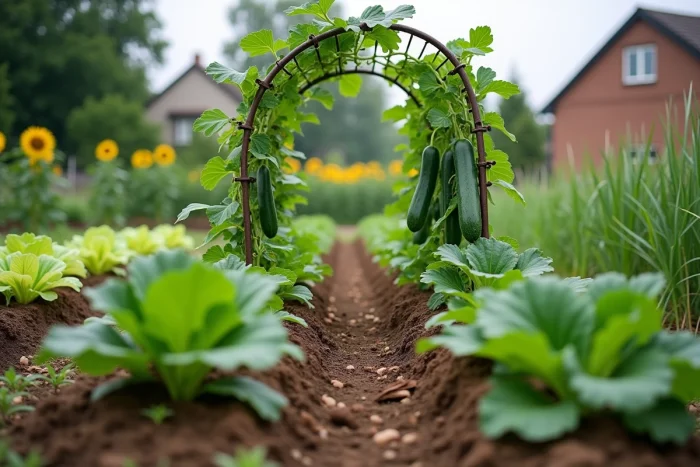
Concrete arrangement: organizing the rows for companionship to work
Spacing is as important as the choice of plants. A cucumber needs space to spread its stems or climb on a support. Placing legumes (peas, beans) about thirty centimeters upstream of the row, on the side from which the prevailing wind comes, protects young plants while gradually enriching the soil.
Ground covers like lettuce or dwarf clover should be placed directly between the plants, in the space that the cucumber will only cover in mid-season. This temporal relay is key: the most useful companion plants are those that occupy space at the right time.
Flowering aromatics (dill, coriander, borage) should be planted at the edge of the bed, not in the middle of the row. They attract helpers without hindering air circulation around the foliage, a point that many gardeners overlook and which promotes the appearance of powdery mildew.
Cucumber remains a vegetable that demands water and warmth. Companionship optimizes growing conditions, but does not replace properly amended soil or regular watering at the base. The best associations are those that adapt to the reality of each garden, its soil, and its exposure.