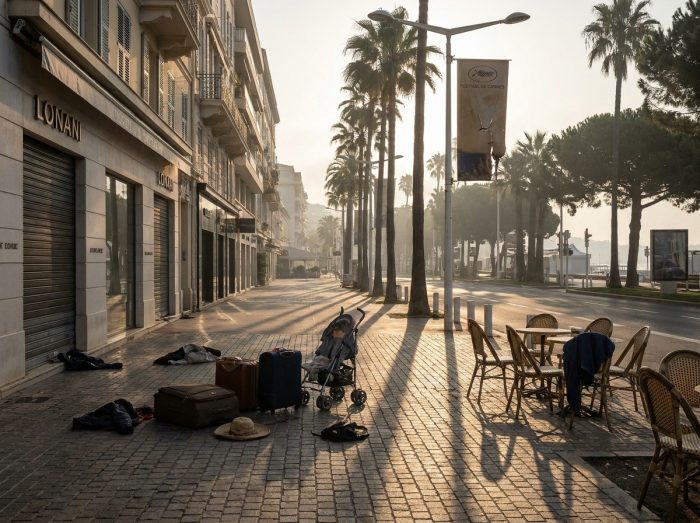
On May 16, 2026, no official source, neither AFP, nor Franceinfo, nor the national anti-terrorist prosecutor’s office (PNAT), qualifies any event that occurred in Cannes as an attack. The term circulates on social media and in certain search queries, but it does not correspond to any terrorist attack confirmed by judicial authorities or intelligence services.
This gap between digital rumor and factual reality deserves to be dissected. Understanding why the word “attack” emerges so quickly, how security protocols function in France, and what the residents of Cannes actually experienced in recent hours helps to place the facts in their context.
Local incident in Cannes and social media frenzy
The event that triggered the confusion seems to be the arrest of a man who threatened a shopkeeper with a knife, an incident reported by TF1 Info in its Justice – Local News section. The Minister of the Interior publicly reacted, which amplified the visibility of the case.
On social media platforms, the sequence accelerated within minutes. Partial videos, screenshots of push notifications, and alarmist comments transformed a local incident into a presumed “attack.” This semantic escalation without judicial validation has been a recurring pattern in France for several years.
For those seeking details of the attack in Cannes today, caution remains advisable: no judicial source links this incident to a terrorist organization, and no investigation by the PNAT has been opened at this stage.
Anti-terrorism protocol in France: what triggers in case of a real attack
France has a precise framework for qualifying an act of terrorism and activating the institutional response. Confusing a violent local incident with an attack amounts to ignoring this mechanism.
Role of the national anti-terrorist prosecutor’s office
The PNAT is solely competent to open an investigation under terrorist qualification. As long as it does not take up a case, the event remains legally a local incident. This distinction conditions everything: the alert level, the resources deployed, government communication.
Vigipirate plan and local devices
In the event of a confirmed attack, several mechanisms are triggered simultaneously:
- The Vigipirate plan moves to “attack emergency” level, allowing for enhanced military patrols and immediate traffic restrictions.
- The prefecture activates a crisis unit and coordinates local security forces, the national police, and the gendarmerie.
- The FR-Alert system sends geolocated notifications to the phones of people present in the affected area, with instructions for lockdown or evacuation.
None of these measures were activated in Cannes at the time of the events. The absence of FR-Alert alone constitutes a reliable indicator: no official alert means no terrorist qualification.
Cannes and the memory of attacks on the Côte d’Azur
The particular sensitivity of the PACA region to rumors of attacks can be explained by a well-documented trauma. The truck attack on July 14, 2016, in Nice, which claimed the lives of 86 people on the Promenade des Anglais, remains etched in the collective memory of coastal residents.
Cannes, located about thirty kilometers away, lives under the same security prism. The Cannes Film Festival, international summits, and the density of tourism make it a city where even the slightest visible police intervention provokes an amplified reaction. Shopkeepers and residents interviewed by local media after the recent incident describe a reflex that has become almost automatic: film, post, alert.
This reflex, understandable after the traumas of Nice and the Bataclan in Paris, produces a perverse effect. Virality systematically precedes verification, and terrorist vocabulary is imposed on situations that do not justify it.
Verify before relaying: the reflexes to adopt in the face of an attack rumor
The propagation of the word “attack” without judicial basis poses a concrete problem. It unnecessarily mobilizes emergency lines, generates panic among relatives of people on-site, and complicates the work of law enforcement.
Several verification points allow for distinguishing a real attack from a frenzy:
- Check if the PNAT has taken up the case, information that is systematically relayed by AFP in the first hours.
- Look for an activation of the FR-Alert system on the networks of telephone operators or on the Ministry of the Interior’s website.
- Consult agency feeds (AFP, Reuters) rather than individual posts on social media, which mix archive images and real-time content.
- Wait for the press conference from the prosecutor or the prefect before using the term “attack” or “terrorism.”
These verifications take a few minutes. They prevent contributing to an anxiety spiral that, in the case of Cannes, is not based on any confirmed factual basis.
Victims of misinformation: a measurable impact on residents
Testimonials collected by local media after such episodes describe lasting anxiety. Shopkeepers in downtown Cannes report a drop in foot traffic in the hours following the dissemination of rumors, even if they are denied. Calls to emergency services increase significantly, sometimes saturating the lines.
Victims of the Nice attack in 2016, supported by assistance associations, regularly testify to the devastating effect of false alerts on their psychological state. Each unverified rumor reactivates post-traumatic stress that years of follow-up do not completely erase.
The Cannes episode of the day illustrates a structural tension: the speed of information on social media far exceeds the capacity of institutions to confirm or deny. The available data does not allow for concluding anything other than an isolated local incident, handled by common law justice. The word “attack” remains, at this time, without official basis to describe what happened in Cannes.