The success of a homemade treat begins before the first technical gesture, at the moment of choosing your utensils. A mold that distorts the baking, an inaccurate scale, or a spatula that melts under heat can turn a simple recipe into a failure. Understanding the precise function of each pastry tool allows you to invest in equipment that truly makes a difference in your preparations.
Baking Mold Materials: Silicone, Stainless Steel, or Non-Stick Coating
The choice of a mold’s material determines how heat reaches the batter. Stainless steel, a quick conductor, produces a well-defined crust and a clean release, provided you butter and flour the mold. It is the reference material for mousses and cakes that need to maintain a sharp vertical structure.
Soft silicone (especially the so-called “platinum-cured” silicone, increasingly common in consumer catalogs) offers a release without grease and a taste neutrality superior to classic silicones. Its flexibility makes it easier to extract complex shapes, but a too-thin silicone mold can warp under the weight of the batter. Checking the rigidity of the base before purchase avoids unpleasant surprises.
To explore the different ranges available, the equipment offered by Gourmandises et Cie covers both classic cake pans and specialized formats for mousses.
Non-stick coated molds remain a good compromise for regular and less demanding use, but their lifespan directly depends on maintenance: any scratch from a knife or fork compromises the coating and releases particles into the baking.
Precision Scale and Thermometer: The Two Instruments That Change Everything
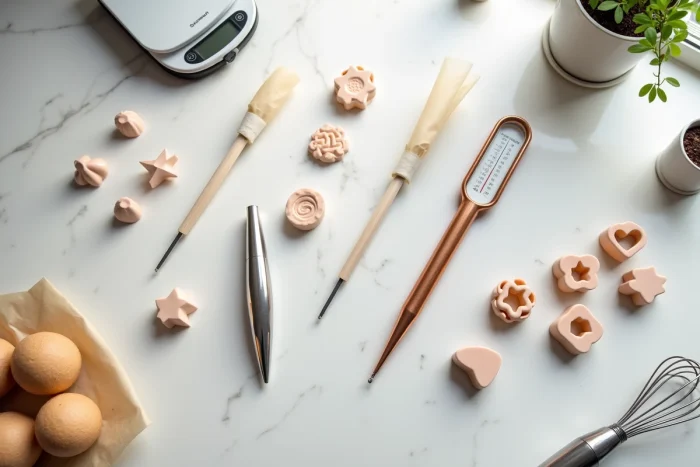
Baking relies on measurements where a few grams of difference can alter the result. An ordinary kitchen scale often displays graduations of five grams, which is sufficient for a yogurt cake but not for a ganache or choux pastry.
A precision scale that measures to the gram transforms the consistency of results, especially for recipes involving baking powder, gelatin, or inverted sugar. Quick-read models, still rarely mentioned in classic guides, reduce weighing time and limit handling errors when pouring a liquid in a stream.
The digital thermometer remains the second underestimated instrument. Checking the temperature of caramel, sugar syrup, or chocolate in a double boiler cannot be done by eye. Without a thermometer, the margin of error for tempering chocolate or cooking custard makes the result unpredictable with each attempt.
What the Thermometer Changes Concretely
- For caramel, the difference between blond caramel and burnt caramel is a matter of a few degrees. The thermometer allows you to remove the pot at the right moment without guessing.
- For tempering chocolate, the temperature curves (melting, cooling, reheating) must be strictly followed to achieve shiny, crisp chocolate.
- A custard thickens properly within a narrow temperature window. Beyond that, the eggs coagulate, and the texture becomes grainy.
Preparation Utensils in Pastry: Spatula, Whisk, and Piping Bag
The spatula (flexible silicone spatula) is used to incorporate whipped egg whites into a batter without breaking them. The “cut-and-fold” motion only works properly with a utensil that is soft enough to conform to the bottom of the mixing bowl, yet firm enough to lift the mass of batter. A rigid spatula crushes air bubbles instead of preserving them.
The hand whisk remains useful even when you have a stand mixer. It allows you to control the texture of a cream or sauce in real time, without risking overworking it. For whipped egg whites and mixtures that require intense aeration, the mixer takes over.
Piping Bag: Choosing the Right Size
The piping bag is not just for decoration. It allows for evenly shaping choux pastry, filling éclairs, or distributing mousse into rings. Disposable polyethylene bags are suitable for occasional use. Reusable coated fabric bags offer better grip and withstand pressure better.
The choice of the nozzle determines the result more than the bag itself. A medium-sized smooth round nozzle covers most needs (choux, éclairs, macarons). A fluted nozzle is used for whipped cream and buttercream decorations. Two well-chosen nozzles are better than a set of twenty that are rarely used.
Baking in the Oven: Silicone Mats, Grids, and Pastry Rings
The silicone baking mat replaces parchment paper and offers a reusable non-stick surface. Its main function is to ensure even baking from below, avoiding the hot spots created by a bare metal sheet. For macarons and tuiles, the mat produces a flat and even base that paper does not always guarantee.
Stainless steel pastry rings serve both as bottomless molds (tarts, mousses) and assembly frames. Their advantage over classic molds: the stainless steel ring allows you to release the piece by simple vertical lifting, preserving the sides of the cake. A standard-sized ring covers most recipes for tarts and individual or family mousses.
The cooling rack, often forgotten in equipment lists, prevents condensation from softening the bottom of a biscuit or puff pastry when it comes out of the oven. Placing a cake directly on a countertop traps moisture under the base and compromises crispness.
Choosing kitchen equipment for homemade pastry does not require an extravagant budget. A few quality utensils, suited to the preparations you actually practice, yield more reliable results than a complete collection of underused accessories. It is better to have a sturdy whisk, a reliable scale, and two good molds than a drawer full of equipment bought out of impulse.