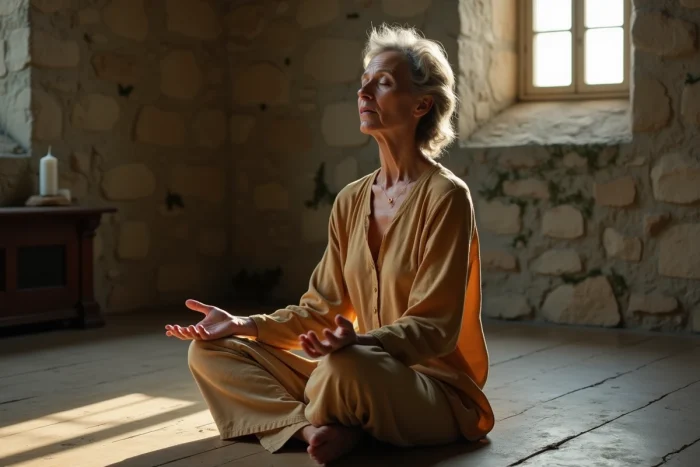
Spirituality occupies a unique place in the French public debate. Long relegated to the private sphere or equated solely with religious practices, it is resurfacing in areas as varied as health, education, and politics. This resurgence is accompanied by tensions: between secularism and the expression of beliefs, between confessional traditions and new forms of the search for meaning, the lines are shifting without a consensus emerging.
Spirituality and public health: a determinant recognized by healthcare systems
The most striking fact in recent years concerns the integration of the spiritual dimension into Western health frameworks. The British NHS strengthened its recommendations in 2022 for palliative care teams to systematically include an assessment of spiritual needs in person-centered care plans. It is no longer just a pastoral accompaniment offered as an option, but a fully recognized health determinant, included in protocols.
This evolution accelerated after the pandemic. Isolation, mass mourning, and confrontation with finitude highlighted what caregivers had long observed: ignoring a patient’s spiritual dimension amounts to amputating care. Research from Quebec, notably by Jacques Cherblanc and Christiane Bergeron-Leclerc, advocates the idea that spirituality permeates all dimensions of overall health, from the physical to the psychosocial.
In France, the situation remains more cautious. The secular framework makes any mention of the “spiritual” in a medical protocol potentially divisive. Field feedback varies on this point: some palliative care services integrate volunteers trained in spiritual accompaniment, while others stick to traditional psychological support. Specialized publications document these intersecting approaches, such as those available on https://revuedeliberee.org/, which address the cultural and intellectual dimensions of these issues.

Digital spiritual communities: when Discord replaces the place of worship
Contemporary spirituality is no longer experienced solely in traditional places of worship. Among 18-35 year-olds, entire communities are forming on Discord, Twitch, or apps dedicated to meditation and collective prayer. These spaces are not limited to passively broadcast content.
They reproduce coded practices: gathering schedules, moderation of exchanges, personalized support. Researcher Heidi Campbell has documented these forms of digital religion with rituals and sustainable engagement in her work on religious practices in new media. The Pew Research Center also dedicated a thematic report to spirituality in the digital age in 2023.
This phenomenon raises unprecedented questions. The legitimacy of an online spiritual guide is not validated by any institution. Sectarian drifts can develop in poorly regulated spaces. On the other hand, these communities offer access to spiritual practice for individuals who are geographically isolated, disabled, or simply distanced from confessional structures.
- “Online churches” operate with weekly meetings, shared prayer times, and thematic discussion groups on Discord or Zoom
- Meditation apps now incorporate paths inspired by contemplative traditions (Buddhism, Sufism, mystical Christianity), not just general well-being
- Moderation in these spaces often relies on volunteers without theological training, raising questions about supporting individuals in distress
Interreligious dialogue and secularism in France: a fragile balance
Considering spirituality in French society requires navigating between two seemingly contradictory demands. Secularism guarantees the neutrality of the State towards religions. Interreligious dialogue, on the other hand, implies recognizing the value of spiritual traditions in building coexistence.
The Collège des Bernardins illustrates this attempt at synthesis. Antoine Arjakovsky and Jean-Baptiste Arnaud argue that the ecumenical perspective allows spirituality to reveal its resources beyond confessional divides. Their approach aligns with Pope Francis’ encyclical Laudato Si’, whose audience extends beyond the Christian realm to touch on shared ecological and social concerns.
The educational field remains the most sensitive. Works like those of François Grenier at Simon Fraser University explore the place of spiritual dialogue in primary schools, in connection with cultural diversity and Indigenous knowledge. In France, the moral and civic education curriculum addresses religious facts, but the boundary between “teaching religions” and “making space for spirituality” remains deliberately vague.
Spirituality and the economy: a dimension absent from development indicators
International frameworks for measuring development largely ignore the spiritual dimension. The Bahá’í International Community proposed a set of spiritual indicators for development as early as the 2010s, articulated around five principles: unity in diversity, equity and justice, gender equality, trust and moral authority, independent search for truth.
These proposals have not been adopted by major institutions. The available data do not allow for conclusions about the measurable impact of spirituality on traditional economic indicators (GDP, HDI). However, correlations exist between social cohesion, institutional trust, and collective spiritual practices, without establishing a causal link.
The issue extends beyond the academic realm. In the workplace, the search for meaning expressed by younger generations translates into concrete expectations: alignment of personal and professional values, refusal of certain missions deemed incompatible with their beliefs, demand for spaces for reflection at work. These phenomena affect both companies and public administrations.
- Several European companies are experimenting with “quiet spaces” open to all traditions, distinct from confessional prayer rooms
- The concept of “spiritual leadership” is gaining ground in management training, with references to contemplative traditions
- CSR policies sometimes incorporate the notion of employees’ “spiritual well-being,” without a standardized framework
Contemporary spirituality escapes the categories that have been used to think about it for decades. It is no longer reducible to religious practice, nor assimilable to mere personal development. It permeates health, education, work, and the digital realm with forms that vary according to generations and cultural contexts. The challenge for a secular society like France is to make space for it without confusing it with confessional faith or diluting it in commercial well-being.