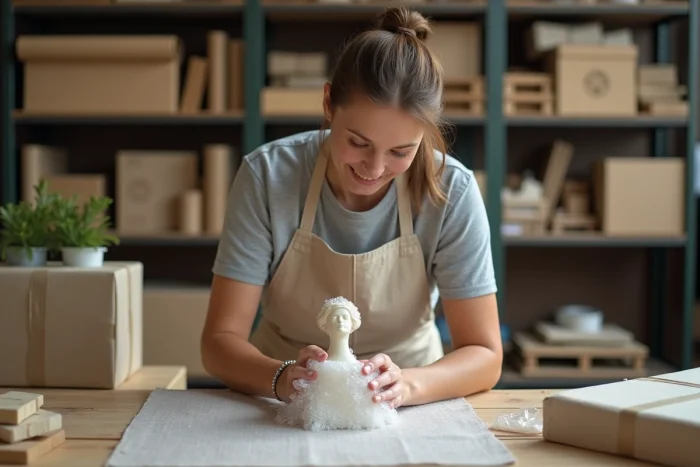
A terracotta, resin, or bronze sculpture does not react to mechanical transport constraints like a framed painting does. The areas of fragility are concentrated on the cantilevered parts (fingers, wings, thin bases), and the variable density from one piece to another radically alters the packing protocol. Packing a fragile sculpture requires three-dimensional reasoning, not just a simple layering of protective materials.
Mapping the break points before packing a sculpture
We recommend starting with a structural examination of the piece, not by choosing the cardboard. Each sculpture has specific areas of mechanical stress: joints between limbs and torso, thin extremities, textured surfaces prone to abrasion from friction.
Place the sculpture on a flat surface and identify the natural support points. A piece resting on a wide base can tolerate a classic vertical packing. In contrast, a sculpture with an off-center center of gravity (leaning bust, moving figure) requires a custom cradle to prevent tipping during transport.
Also check the surface condition. A fragile patina, cracked glaze, or gold leaf requires a first layer of acid-free tissue paper before any contact with packing material. Bubble wrap applied directly to a glazed surface can leave permanent circular marks due to pressure and heat buildup in the package.
We regularly observe damage not from shock, but from prolonged vibration. Ceramic or glass pieces are particularly sensitive to repeated micro-vibrations on a road trip. The packing must absorb vibrations as well as impacts.
To delve deeper into the subject of protecting three-dimensional pieces, it is useful to understand how to ship a fragile sculpture with 100,000 Watts by adapting the principles to larger formats.
Internal packing and double box technique for sculptures
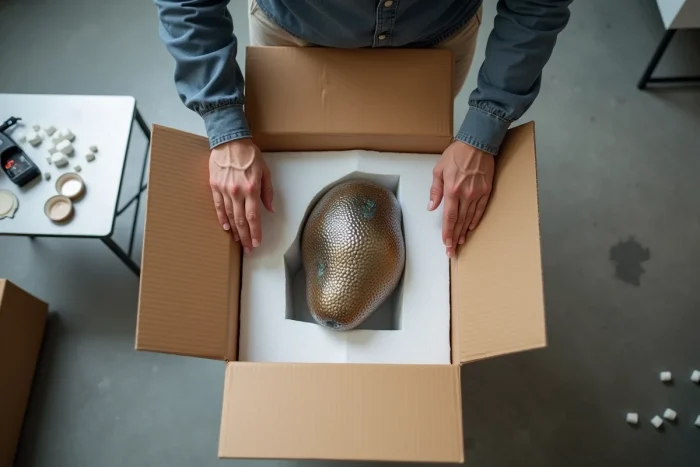
The double box technique remains the reference protocol for shipping fragile sculptures. The principle is simple, but its execution requires rigor: the sculpture, wrapped and packed in a first box, is itself inserted into a larger second container, with the interstitial space filled with an absorbing material.
The internal packing of the first box must conform to the shape of the piece. Closed-cell polyethylene foam, cut with a knife to the negative shape of the sculpture, offers the best immobilization. Unlike standard open-cell foam, closed-cell foam does not compress under the weight of the piece during transport.
Recommended packing sequence
- Wrap the sculpture in acid-free tissue paper, then in a layer of soft foam to protect the surface from any direct friction with the rigid packing.
- Cut blocks of polyethylene foam to form a cradle that fits the contours of the piece, leaving a minimum of two centimeters of thickness between the sculpture and each internal wall.
- Fill any remaining voids with cellulose wadding or crumpled kraft paper, never with polystyrene chips that migrate and leave unprotected areas.
- Close the first box, place it in the second, and fill the intermediate space with crumpled paper or bio-based foam to create a shock-absorbing suspension.
Each cantilevered part must be packed individually. An outstretched arm or thin fin deserves its own block of foam, independent of the general packing. Securing these protruding elements to the main body with painter’s masking tape (low adhesion) before packing significantly reduces the risk of breakage.
Protective materials: bio-based foam, wadding, and alternatives to bubble wrap
The industry is moving towards eco-friendly packing solutions. Several carriers and specialized workshops report a gradual shift from plastic bubble wrap to bio-based foams, cellulose wadding, and multi-layered crumpled papers, especially for glass and ceramic pieces.
Lumière & Vitrail describes a multi-layer packing protocol combining foams, reinforcements, and packing specifically adapted for glass works. This approach reflects a broader trend of replacing single-use plastics with technical materials in the fragile works sector.
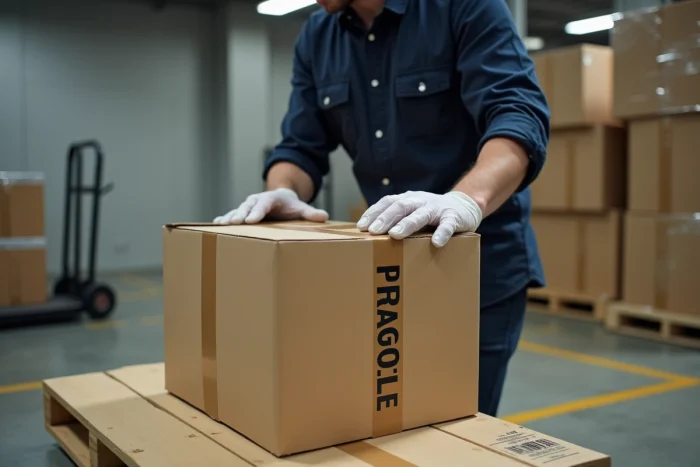
Cellulose wadding has an often-overlooked advantage: it partially regulates humidity inside the package. For an unglazed terracotta sculpture, this is a criterion to consider, as high humidity during transport can cause salt efflorescence on the surface.
We recommend avoiding crushed cardboard in direct contact with the piece. Its irregular rigidity creates localized pressure points, particularly harmful on thin convex surfaces. Crushed cardboard remains useful for filling the outer box, but never as the first layer of packing.
Ad valorem insurance and condition indicators in transit
Impeccable packing does not exempt one from anticipating loss. Specialized art transporters offer ad valorem insurance, calculated based on the declared value of the piece, with specific claims procedures that differ radically from the general conditions of a general carrier.
Museums and major shippers now combine double-walled boxes with insulating foam and temperature and humidity indicators inserted into the package. These passive witnesses allow one to know if the sculpture has been subjected to extreme environmental conditions during transit, a decisive piece of evidence in case of a dispute with the carrier.
The “fragile” label alone offers no contractual guarantee. It signals an intention, not an obligation of enhanced means. True protection comes from the choice of carrier, the declaration of value, and the quality of internal packing.
The last point to check before final closure: gently shake the finished package. If any movement is perceptible inside, the packing is insufficient. Reopen, repack, close again. This step takes two minutes and avoids regrets upon arrival.