
A Vogue magazine does not gain value simply because it has aged. The value of an issue depends on a combination of original print run, condition, and the notoriety of the cover. Some copies lie in attics worth little, while others fetch several hundred euros at specialized auctions.
Vogue France after the rebranding: issues already monitored by collectors
At the end of 2021, Vogue Paris dropped its historic name to become Vogue France. This change is not just about a logo: it marks an editorial break, with new leadership, a redesigned layout, and a more inclusive repositioning. Specialized dealers in collectible press already identify these first issues post-rebranding as milestones to keep.
Their rarity is not immediate. The print runs remain comparable to previous editions. Their interest lies in the fact that they document an institutional turning point in the history of the title. For a collector, owning the very first copy bearing the mention “Vogue France” is akin to holding a marker of transition, comparable to the first issues of a new format in illustrated press.
On press sales platforms, these issues are now isolated as a distinct sub-series, which facilitates trends on Carnet de Tendances for those tracking market evolution. Prices have not yet skyrocketed, but the structured demand leaves little doubt about their trajectory.
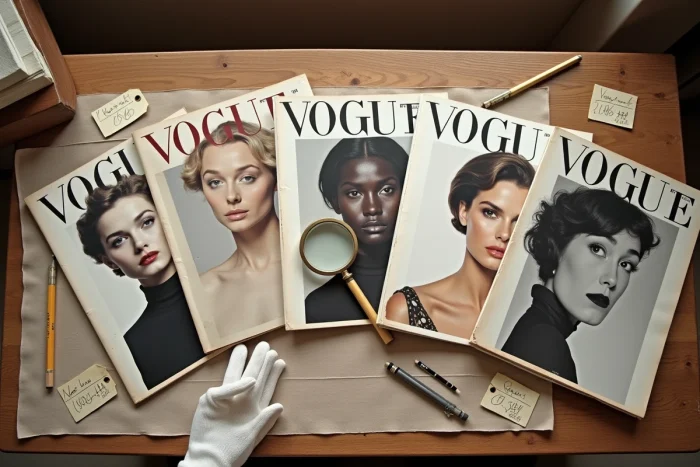
Vogue Collections Special Issues: a value driven by professional demand
The “Collections” special issues of Vogue France hold a unique place in the secondary market. Unlike monthly issues, they document in depth the silhouettes of an entire season. Sometimes they are the only print materials to offer comprehensive coverage of the fashion shows.
This specificity gives them a utilitarian function that goes beyond nostalgia. Stylists, costume designers, and fashion students seek them out as working references. The demand is not only driven by collectors but also by professionals who need these visuals for their projects.
Even recent special issues, printed more widely than issues from the 1960s or 1970s, are experiencing rapid revaluation. A copy in good condition, complete and without torn pages, can see its price double in just a few years on second-hand platforms.
Technical criteria that drive up the price of vintage Vogue
Not all old Vogues are equal. Three parameters concretely determine the market value of a copy in the collectible market.
- The condition takes precedence over everything else. An issue from the 1960s with a crumpled cover, yellowed pages, or a broken spine loses the majority of its value. Demanding collectors seek “near mint” copies, with intact binding and faithful colors.
- The notoriety of the cover plays a decisive role. A portrait signed by a renowned photographer, or featuring a personality who has become iconic since publication, drives the bidding well beyond a standard issue from the same period.
- The original print run and actual rarity matter more than age. A 1950s issue printed on a large scale will be worth less than a limited edition from the 1990s that is now hard to find. The first issues of a series or a relaunched format are particularly sought after.
Beware of AI-generated counterfeits
A recent phenomenon complicates the task for buyers: counterfeits of Vogue covers produced by artificial intelligence are circulating in the market. These reproductions mimic period typography, paper grain, and photographic compositions with unsettling realism.
For a collector, verifying the authenticity of a vintage copy has become an essential reflex. Examining the paper (weight, texture, smell), comparing with databases of referenced issues, and documented provenance remain the best safeguards.

Vogue lots at auction houses: a structuring but little-known market
Record sales of Vogue magazines do not always concern isolated copies. Auction houses regularly offer thematic lots grouping several decades of publications. These lots structure the market far more than individual transactions, as they set reference prices for dealers and informed collectors.
A coherent lot (for example, a complete decade of French Vogue in good condition) reaches amounts that the sum of the issues sold separately would not achieve. The completeness of a series multiplies the value of each copy it contains.
This lot-based approach explains why some collectors prefer to buy in bulk rather than individually. The strategy is to build a complete series and then offer it for sale as a group to maximize the final price.
Digital Vogue and NFTs: a new collecting ground
The digital editions of Vogue and the NFTs related to the magazine create hybrid collectible objects. These formats lack the materiality of a paper copy, but they introduce programmed rarity (limited digital print run, certificate of authenticity on blockchain) that attracts a different profile of buyers.
The market remains young and volatile. The value of these pieces depends more on speculation about digital assets than on traditional criteria of press collecting. For a classic collector, paper retains the advantage of tangibility and a more readable price history.
The Vogue issues that are worth a fortune share a common point: they document a specific moment, whether it be a name change, a cover that has become legendary, or a season of shows that cannot be found elsewhere. Value follows actual rarity, not presumed age. Examining condition, verifying authenticity, and understanding the logic of auction lots remain the foundation of any serious collection.