The family organization often struggles with the structural distribution of mental load, digital blind spots, and a lack of awareness of recent legal provisions. Here are the levers that can concretely change the daily lives of families.
Parental mental load: assign complete domains, not isolated tasks
Asking a partner to “participate” in grocery shopping or medical follow-ups for the children does not reduce mental load. Assigning an entire domain eliminates the supervision loop. The difference is structural: the person managing a domain ensures anticipation, appointment scheduling, follow-up, and reminders, without a third party needing to verify.
Women continue to bear a majority of domestic and parental tasks. As long as the distribution relies on occasional “help,” the imbalance persists.
We recommend breaking family life into autonomous blocks: food (menus, shopping, cooking), health (appointments, vaccinations, pharmacy), administrative (bills, insurance, school), textile logistics (laundry, seasonal clothing). Each block is assigned to an adult in the household, who becomes the unique point of reference. To consult astuces-parents.com for families seeking concrete guidelines on these distributions, it’s a good complementary starting point.
Screens and children: abandon the hourly threshold for a contextual approach
Setting a limit of “two hours a day” without distinguishing age, content, or time of day is an outdated strategy. The Enabée study from Santé publique France, published in 2025, shows that screen time significantly increases on non-school days and varies greatly by age. Recent French recommendations now prioritize five evaluation criteria rather than a universal hourly cap:
- The child’s age, with differentiated thresholds for under three years, three to six years, and over six years
- The nature of the content consumed (educational, passive recreational, interactive)
- The measurable impact on sleep and daily physical activity
- The presence or absence of an adult during use
- The context of use (school day, weekend, vacation)
In practice, a child watching a documentary with a parent on a Sunday afternoon does not pose the same issue as solitary and passive use on a school evening. Evaluating the context rather than counting minutes allows for adapting the rules to reality.
Parental control: frame without constant monitoring
Parental control tools integrated into operating systems (Android Family Link, Apple Screen Time) allow for setting time slots, filtering content, and receiving usage reports. The goal is not to micromanage but to establish a technical framework that frees parents from constant vigilance.
Unknown legal provisions that lighten parental daily life
Since January 2025, several legal developments directly concern working families. Ignoring them means depriving oneself of real maneuvering margins.
Remote work, when accessible, remains a powerful lever. Recent case law clarifies that employers are not always required to justify a refusal, but collective agreements in many sectors now impose a formalized discussion framework. Checking one’s collective agreement before accepting an oral refusal is a reflex to adopt systematically.

Textile management and meals: the two areas where batch processing saves the most time
Food and laundry are the two areas where batch processing yields the most measurable time savings.
Meals: group preparation as a system
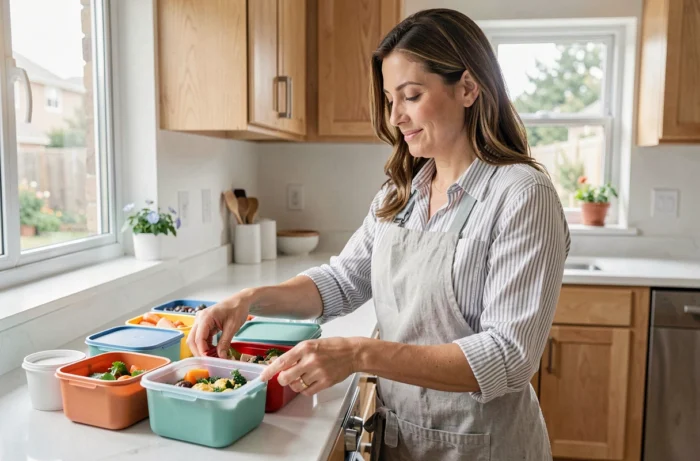
Preparing the culinary bases for the week in a single session reduces the number of daily decisions. The principle is not to cook five complete dishes on Sunday, but to prepare reusable components: cooked proteins, grains, sauces, chopped vegetables. During the week, assembly takes less than twenty minutes.
Clothing: radical seasonal sorting
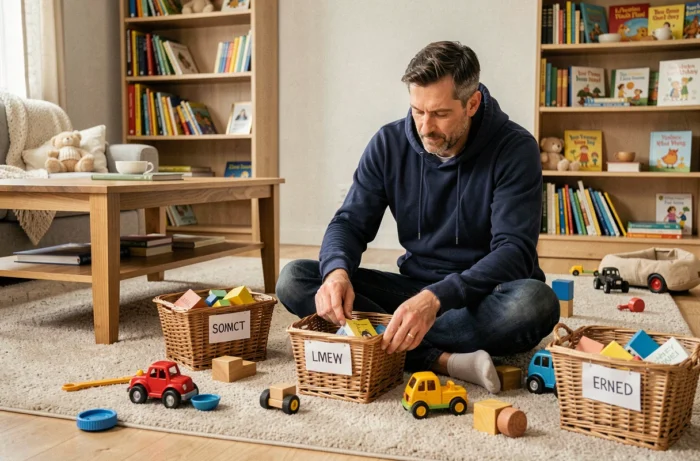
The volume of laundry is directly proportional to the number of clothes in circulation. Reducing each child’s active wardrobe to a limited number of outfits suitable for the current season decreases laundry loads, sorting, and storage. Off-season clothes are stored in a single bin per child, labeled by size.
- A preschool child operates with five complete outfits and two spare outfits, excluding coats
- Accessories (hats, gloves, scarves) are grouped in a single bin near the entrance, not in the bedrooms
- Dirty laundry is sorted at the time of deposit (one bin for colors, one bin for whites) to eliminate the sorting step before washing
Fewer clothes in rotation mechanically produce less logistical load. This simple principle generates the most immediate gain in families with multiple children.
The advice that truly transforms the daily lives of families touches on structure: who decides, who anticipates, what rights are mobilized, what volumes are reduced at the source. These three levers produce visible results quickly, provided they are applied as operating rules rather than as occasional adjustments.