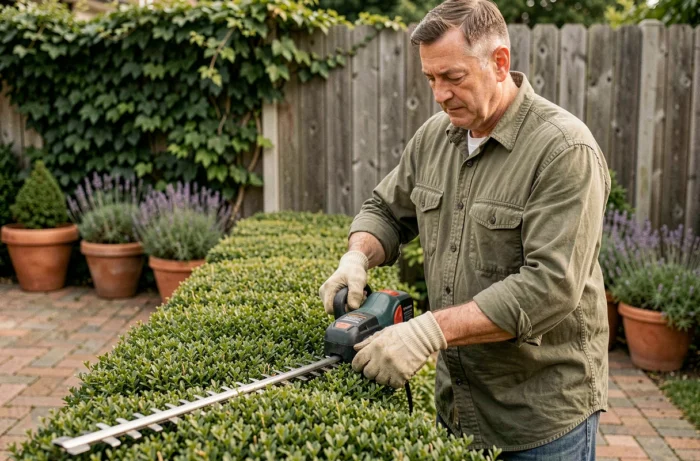
The hedge trimmer market is divided into three power supply families (corded, battery, gas) and dozens of models with prices varying in a ratio of one to twenty according to Que Choisir. Behind this abundant offer, the choice relies on a few specific technical parameters, but also on regulatory constraints that most buying guides do not address.
Hedge trimmers and regulations: how noise and biodiversity affect tool selection
Choosing a hedge trimmer without considering the local legal framework is akin to buying a tool that cannot be used when needed. Two regulations directly influence the type of machine to prioritize.
The first concerns noise. There is no single national schedule for gardening equipment: the permitted time slots vary according to municipal or prefectural orders. A gas model, significantly noisier than a battery model, effectively restricts usage times. In some municipalities, noisy work is limited to a few hours on Saturday and prohibited on Sunday. A battery hedge trimmer, being quieter, offers more flexible working hours.
The second constraint relates to biodiversity. The agricultural orientation law of March 24, 2025, established a regime for the protection and sustainable management of hedges. Prefectural orders must set pruning prohibition periods adapted to local nesting periods.
The OFB recommends avoiding pruning from March 15 to July 31, and the LPO extends this recommendation until August 31. The destruction of a nest of a protected species is prohibited year-round, including in a private garden. Before any intervention, a visual inspection of the hedge is essential.
These two factors guide the choice: a silent device expands working time slots, and a manageable model allows for short sessions outside sensitive periods. Specialized resources like taille-haie-warrior.com enable comparisons of models based on these often-overlooked practical criteria.
Tooth spacing and cutting diameter: the technical criterion that price does not reveal
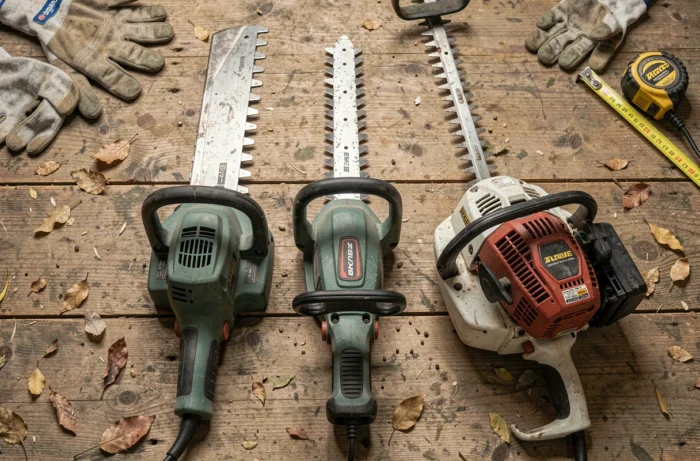
The motor power receives all the attention in comparisons. The spacing of the blade teeth deserves at least as much consideration, as it determines the maximum diameter of branches that the tool can cut cleanly.
A hedge trimmer with closely spaced teeth is suitable for young hedges, topiaries, and species with fine foliage (boxwood, privet). The cut is clean, and the visual result is precise. Conversely, when faced with thicker branches (cherry laurel, eleagnus), the tool may jam or tear the branch instead of cutting it.
In contrast, a wide spacing accommodates larger diameter branches but results in a less tidy finish on fine hedges. The choice thus directly depends on the plant species present in the garden.
- For boxwood, hornbeam, or privet hedges: a tight spacing and a short blade are sufficient, with precision taking precedence over power.
- For laurel, photinia, or Leyland cypress hedges: a medium to wide spacing is preferable, with sufficient motor power to avoid straining the woody branches.
- For mixed or old hedges with dense branches: a gas model or a high-voltage battery remains the only realistic option for smooth work.
Checking the tooth spacing before purchase avoids the frustration of an undersized tool. A powerful hedge trimmer with inappropriate spacing cuts poorly, regardless of its price.
Actual weight and muscle fatigue: why the technical sheet is not enough
Product sheets indicate an empty weight. For a battery model, the weight of the battery must be added. For a gas model, the weight of the fuel. The difference between the stated weight and the weight in real conditions can sometimes reach several hundred grams, which changes the dynamics during a prolonged trimming session.
The hedge trimmer is operated with arms extended, often above shoulder height. A tool weighing a few kilograms becomes exhausting after twenty minutes in this position. Two factors alleviate fatigue: weight distribution (a rear motor balances better than a central motor) and the presence of a rotating handle, which allows switching from horizontal to vertical cutting without twisting the wrist.
Field feedback varies on this point: some users prefer a slightly heavier but better-balanced model over an ultra-light model with a poorly placed center of gravity. Before buying, handling the tool in-store provides information that the technical sheet does not offer.
Blade length and hedge height
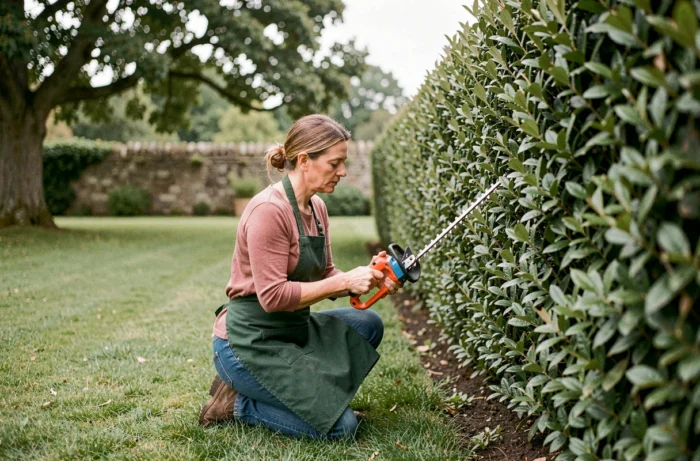
A short blade offers more maneuverability for shaped forms and small gardens. A long blade covers more surface area with each pass and reduces working time on linear hedges. For tall hedges, a pole hedge trimmer avoids the use of a stepladder, but its cantilevered weight significantly increases muscle effort. The pole is justified only for hedges that are regularly trimmed beyond shoulder height.
Battery, corded, or gas: deciding based on area and trimming frequency
The three types of power supply do not meet the same garden configurations. The corded model remains the cheapest and lightest but requires an extension cord and a nearby outlet. Its range is limited.
The battery model currently dominates the consumer market. Its autonomy depends on the voltage and capacity of the battery. An undersized battery forces recharging during a session, which doubles the working time on a long hedge. Checking compatibility with an existing battery fleet (lawnmower, blower) can reduce the entry cost.
The gas model retains the advantage for very long dense hedges, where battery autonomy reaches its limits. However, it requires regular engine maintenance (air filter, spark plug, oil-gas mixture) and generates a noise level that restricts usage times in residential areas.
The right hedge trimmer is not the most powerful or the cheapest. It is the one whose spacing matches the hedge, whose weight remains manageable over the duration of the session, and whose power supply aligns with the constraints of the terrain and neighborhood.